


Pricing Guide: How to Charge for Your Creative Work
How to Charge for Your Creative Work: Many creative professionals teach us how to design, research, develop concepts and master tools, but very few teach us how to price our work. On top of that, we're passionate about what we do, and sometimes struggle to separate that passion from the financial value of our work.
You know the feeling: a new project comes your way, you’re excited about it, you start imagining how you’d bring it to life, and then, when it’s time to put together the quote, the big question comes up: how much should I charge? You open a document, estimate the hours you’ll need, multiply them by a figure that seems reasonable, and start second-guessing yourself. Is it too much? What if the client doesn’t accept it? What if I don’t have enough experience to charge that much?
If you work in design, illustration, photography, product design or interior design, you’ve probably found yourself in this situation more than once. And there’s something we want you to know: you’re not the only one who struggles to put a price on their work.
The result is often the same: underpriced quotes, unaccounted hours, endless rounds of revisions and deliverables that keep multiplying without any increase in the fee.
Quick answers
- Pricing your creative work isn’t about asking for more money just because you can. It’s about applying a method that takes your costs, the complexity of the project and usage rights into account.
- Charging by the hour alone can penalise your experience: the better you become at what you do, the faster you work, meaning you earn less if you keep the same hourly rate.
- Your baseline costs are the minimum you need to cover to make a project profitable.
- Deliverables and usage rights are part of the quote: delivering a single asset is not the same as developing a campaign or granting usage rights for several years.
- The most common mistake is quoting a price without understanding the full scope of the project, including revisions and usage terms.
Don’t worry: struggling to price your work doesn’t mean you’re not a good professional. It probably means nobody has ever taught you how to do it. In the creative world, passion, insecurity and the fear of missing out on opportunities often go hand in hand. But learning how to charge for your work is also part of building a sustainable career.
If you work in branding, think about how a well-executed corporate visual identity can transform a brand’s perception and positioning. That knowledge, creative judgement and impact are all part of the value you bring to the table.
In this guide, we’ll leave improvised figures behind and build a pricing structure you can confidently explain and stand behind in front of any client.
Common mistakes (the ones that happen most often)
- Calculating your price based on hours alone, without accounting for meetings, emails, taxes, professional development or the months when you have no projects.
- Quoting without a proper brief, without understanding the deliverables, the actual scope or who makes the decisions.
- Giving away usage rights for free, without defining the scope, territory, duration or exclusivity.
- Accepting additional changes and deliverables without adjusting the price, for fear of making the client uncomfortable.
- Working without a contract or upfront payment, leaving yourself exposed to endless changes and late payments.
Not knowing how much to charge for creative work isn’t a lack of talent or negotiating skills. More often than not, it comes down to not having a clear method for valuing your time, experience and the scope of what you deliver.
Charging by the hour is one of the first pricing methods we turn to when we start working independently. It seems logical: you estimate how long a project will take, set an hourly rate and send the quote. However, this model has one major flaw: it focuses on the time you invest, rather than the value of the final result.
This can work against you in several ways:
-
It penalises you for getting better. If a junior designer takes ten hours to create a logo and you, with years of experience, can do it in two, it makes no sense for your work to be worth five times less simply because you’re more efficient.
-
It turns creativity into a stopwatch. A great idea might come after researching, observing or experimenting. Clients aren’t just paying for the hours you spend in front of a computer, but for your ability to find the right solution.
-
It invites haggling. When the price depends on the hours worked, clients can easily question how long a task should take. When you present the value of the outcome and its deliverables, the conversation changes.
-
It overlooks invisible work. Finding references, preparing proposals, developing your skills, managing clients, maintaining tools and organising your business all take time and money.
This doesn’t mean you should stop tracking your hours. Quite the opposite: you need to understand them to calculate your costs. The difference is using them as an internal reference rather than necessarily making them the unit that determines your final price.
Tip: Before sending a quote, ask yourself what problem you’re solving and what value your work brings to the client: increased sales, brand awareness, differentiation or time savings. The answer will help you communicate the value of your proposal.
A creative quote shouldn’t be based on a made-up figure or what you think the client is willing to pay. To build one properly, you need to consider three key elements: your baseline costs, the complexity of the project and usage rights.
Step 1: Calculate your baseline costs (your minimum)
Before thinking about how much to charge for a project, you need to know how much it costs to run your professional business. To calculate this, add up:
- Your annual fixed expenses: self-employment contributions, accounting services, software and subscriptions, equipment, workspace, insurance and professional development.
- Your target salary: how much you need to earn each year to live comfortably. Don’t confuse revenue with your actual salary.
- Taxes and financial buffer: account for your tax obligations and set aside a margin for holidays, sick leave, unexpected expenses and quieter months. Remember that VAT isn’t your income.
- Your actual billable hours: nobody can bill for every hour they work. Between meetings, administration, communication and finding new clients, only part of your time is genuinely billable.
With these figures, you can establish an internal reference rate. You don’t necessarily have to use it to charge by the hour; it’s there to help you understand the minimum you need to cover.
Your baseline cost is the floor, not the ceiling of your price. If a project doesn’t cover your costs and the work involved, it’s probably not profitable.
Step 2: Assess the complexity of the project
Two projects that look similar can require very different levels of effort. Before preparing a quote, consider:
- Scope: How many deliverables are included? A logo or a complete visual identity? A single illustration or an entire collection?
- Revision rounds: How many rounds of revisions are included? Set a specific number and establish how much additional revisions will cost.
- Deadlines: Is it an urgent project that requires you to reorganise your schedule or turn down other work?
- Uncertainty: Does the client have a clear brief? Are several people involved in the decision-making process? Could the scope change along the way?
- Specialisation: Do you need specific technical knowledge, experience or expertise to complete the project?
A practical way to organise this component is to use indicative multipliers: x1 for a straightforward project, x1.5 for a medium-complexity project and x2 or higher for a complex one.
The key isn’t to apply a universal figure, but to understand what makes a project require more time, knowledge, responsibility or resources.
Step 3: Price usage rights and licensing
This is where many creatives leave money on the table, sometimes without even realising it. Delivering a file doesn’t mean transferring all rights to use it forever.
Imagine you create an illustration for a brand. There’s a big difference between using it in a one-off social media post and featuring it on the packaging of a product sold nationwide for five years. The creative work may be the same, but the scope of its use is completely different.
To determine the price of this component, define:
- Usage: Where will it be used? (social media, websites, packaging, outdoor advertising, media).
- Territory: Local, national or international?
- Duration: One year, five years or in perpetuity?
- Exclusivity: Can you reuse or license the work to other clients?
- Full rights transfer (buyout): If the client requests a broad transfer of rights, the terms must be explicitly defined and priced accordingly.
If you want to understand how the transfer of exploitation rights is regulated in Spain, consult the consolidated text of the Spanish Intellectual Property Law, published in the Official State Gazette (BOE). And remember: the agreed terms should be included in the contract or proposal, not just discussed verbally.
Usage rights are part of the price of any creative project. You’re not simply delivering a file; you’re also defining the specific terms under which it can be used.
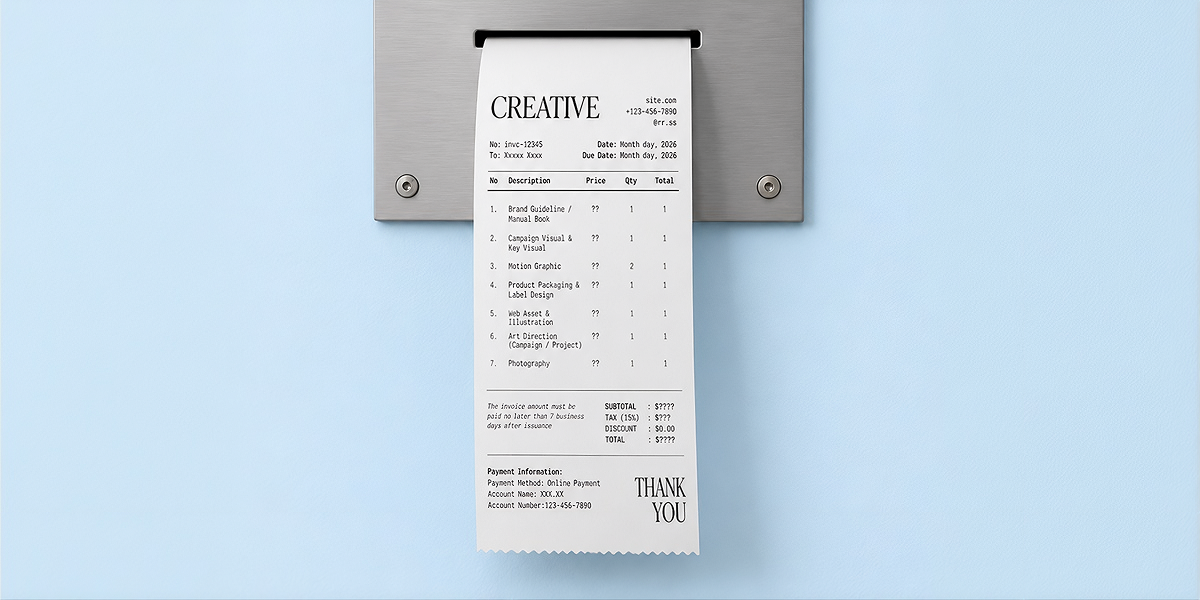
Now that we’ve covered the three pillars, we can bring them together in a simple formula:
Baseline Costs + Complexity + Usage Rights / Licensing = Final Price
An example: imagine you’re an illustrator and a cosmetics brand commissions an image for an advertising campaign.
-
Baseline costs: You need to cover the time spent on research, concept development and production, as well as your professional operating expenses.
-
Complexity: The project has tight deadlines, requires a specific technique and includes three rounds of revisions.
-
Licensing: The brand wants to use the illustration in outdoor advertising and on social media across Spain for two years.
With these elements, you can build a price that reflects both the work involved and how the client intends to use it.
And if the client needs to work within a tighter budget, you don’t have to give away your time or automatically lower your rate. You can propose fewer deliverables, fewer rounds of revisions, a more limited territory or a shorter licensing period.
If the budget goes down, adjust the scope. Not the value of your work.
The formula above helps you establish a pricing foundation, but there are different ways to present your fees. Each model works best depending on the type of project and your relationship with the client.
Project-Based Pricing (Fixed Fee)
You set a single price for the entire project, provided the scope is clearly defined. The client knows exactly how much they’ll pay, and you can organise your resources and time without turning every task into a billable hour.
This works particularly well for visual identity projects, commissioned illustrations or product photography sessions.
Value-Based Pricing
With this model, you consider the impact your work can have on the client. Developing a visual identity for a company launching a new business line may have a very different strategic value from creating a one-off asset for internal use.
Your price isn’t based solely on how long the work takes, but on what it helps the client achieve.
Fixed Packages
You can offer three service tiers (Basic, Standard and Premium), each with different deliverables, revision rounds and usage rights.
This helps clients understand exactly what they’re getting with each option and makes decision-making easier, without having to negotiate every individual element.
Retainer or Monthly Fee
This involves setting a monthly fee in exchange for a predefined amount of work or a set of recurring services.
It’s a great option for creative professionals who regularly collaborate with brands, companies or studios. It helps you organise your schedule more effectively and build greater income stability.
There is no single pricing model that works for every creative professional. The best one is the model that suits the project, protects your profitability and makes it clear what the client is getting.
Your baseline costs help you understand the minimum you need to charge, but it’s also useful to know how other professionals price their work and which models are commonly used across the industry.
These two websites can be a good starting point:
Domestika’s Freelance Work & Business Forum
In the thread Standard Rates for Freelance Graphic Designers, you’ll find discussions between professionals about pricing projects, charging by the hour or by the project, and finding industry benchmarks.
It’s a good way to see that pricing concerns are shared by many creatives. However, the thread was started in 2012, so the figures are outdated. Use it as a reference for pricing methods and professional experiences, not as a list of current rates.
Fiverr (Graphics & Design Category)
The Fiverr marketplace allows you to see how other professionals structure their services: different pricing tiers, deliverables, turnaround times and included revision rounds.
You can also check out its guide to graphic design pricing and rates.
Keep in mind that it’s an international marketplace where very low-cost services coexist with projects worth thousands of dollars. Don’t use it as a direct benchmark for setting your own prices, but rather as inspiration for learning how to present and structure your services.
Tip: Compare multiple sources, talk to professionals in your field and check out creative associations or communities. But don’t forget to come back to your own numbers: market benchmarks can guide you, but your costs set the baseline.
You can have a perfectly calculated price and still lose profitability because of the way you present your proposal.
Here are some common mistakes:
-
Sending a figure without explaining what’s included, leaving the client unsure of what they’re actually paying for.
-
Talking exclusively about hours, instead of explaining the results, deliverables and value of your work.
-
Responding to “that’s too expensive” by automatically lowering your price, without asking which part of the project needs adjusting.
-
Failing to request an upfront payment, taking on all the risk before the work even begins.
-
Not reviewing your rates, even when your experience, costs or specialisation have changed.
Tip: Always present your proposal in writing, clearly outlining the scope, deliverables, revision rounds, deadlines, usage rights and payment terms. A well-structured quote communicates professionalism before the client has even seen a single piece of your work.
1. I’ve calculated my baseline costs and know the minimum I need to cover.
2. I’ve assessed the project’s complexity: scope, revisions, deadlines and uncertainty.
3. I’ve clearly defined all the deliverables the client will receive.
4. I’ve established the usage rights: scope, territory, duration and exclusivity.
5. I can explain my pricing without justifying it solely in terms of hours worked.
6. I’ve specified in writing the included revisions and the cost of any additional ones.
7. I have an approved contract or proposal and have agreed on the payment terms.
A well-structured proposal doesn’t just help clients understand what they’re paying for. It also allows you to protect your time and avoid misunderstandings throughout the project.
You can structure it as follows:
Context: Explain what the client needs and what they want to achieve with the project.
Scope: Outline the deliverables included in your proposal and, just as importantly, what is excluded.
Process and Timeline: Define the different stages of the project, key dates and the number of revision rounds included.
Licensing: Specify where, for how long and in which territory the client will be allowed to use your work.
Investment: Present the final price, either broken down by individual budget items or through different packages, and include the payment terms.
Next Steps: Explain how the client can accept the proposal and when you can get started.
A quote that clearly explains what’s included, what’s excluded and what the client will receive conveys far more professionalism than one that simply displays a final figure.
Is charging by the hour always a mistake? Not necessarily. It can be useful for tasks that are difficult to define in advance or for consultancy work. However, for creative projects with clearly defined deliverables, setting a project-based fee is often more suitable. Use your hours as an internal reference to calculate your costs, rather than necessarily as your billing method.
How do I know how much I should earn per year? Start by adding up your annual business expenses and the net salary you need. Factor in the relevant taxes and a financial buffer for unexpected expenses. Then calculate your actual billable hours. This will give you a benchmark for determining your baseline costs.
Should I charge more if the client is a major brand? Not necessarily because of its size, but because of the scope, impact and usage terms of the work. A large-scale advertising campaign may require a broader licence than a one-off publication. Your price should reflect what is requested and what you deliver.
What should I do if a client says my price is too high? Before lowering it, ask which part of the budget they need to adjust. You can suggest fewer deliverables, fewer revisions, longer deadlines or a more limited licence. This allows you to maintain consistency between the price and the work involved.
When should I raise my rates? Review your prices at least once a year, and whenever your costs, experience, specialisation or demand for your services change.
Pricing your creative work isn’t just an administrative task: it’s one of the most important strategic decisions you can make when building a sustainable professional career. Learning how to prepare quotes helps you manage clients more effectively, choose the right projects and recognise the value of everything you bring to the table.
And remember: the value of your work isn’t determined solely by the hours you put in, but also by your experience, judgement, creativity and the results you’re able to achieve.