



Creative Systems: Generative AI and new creative processes with El Feo Revollo
Last Wednesday, 18 March, LABASAD hosted a session that proved essential for understanding the current landscape and the future of the creative industries.
Under the title “Creative Systems: Generative AI and New Creative Processes”, El Feo Revollo guided us through a Masterclass designed to explore how artificial intelligence is transforming the sector far beyond the mere use of new tools.
The session stemmed from a clear premise: true change doesn’t lie in specific prompts or platforms, but in the processes, methodologies, and systems of ideas that allow technology to be integrated into actual workflows. El Feo stressed that while everything moves at breakneck speed, with improved models appearing in a matter of weeks, certain elements remain constant within the technological flow.
For today’s creative, it is vital to understand that ideas do not necessarily need a brand to come to life. Generative AI is opening a door where the real premium is placed on the ability to generate concepts, which were previously viewed simply as a service delivered in blocks. Today, the “prompt” or instruction is, in essence, the idea itself.
One of the most poignant moments of the Masterclass was the need to balance AI with human discernment. El Feo emphasised that the output of generative models is directly proportional to the creative’s own capabilities:
Results and expertise: Poor results are usually a symptom of how instructions or flows are structured; AI responds to our own depth of knowledge on a subject.
Datasets and transparency: All models are built upon vast information repositories (datasets), and in many cases, there is a lack of total transparency regarding their training.
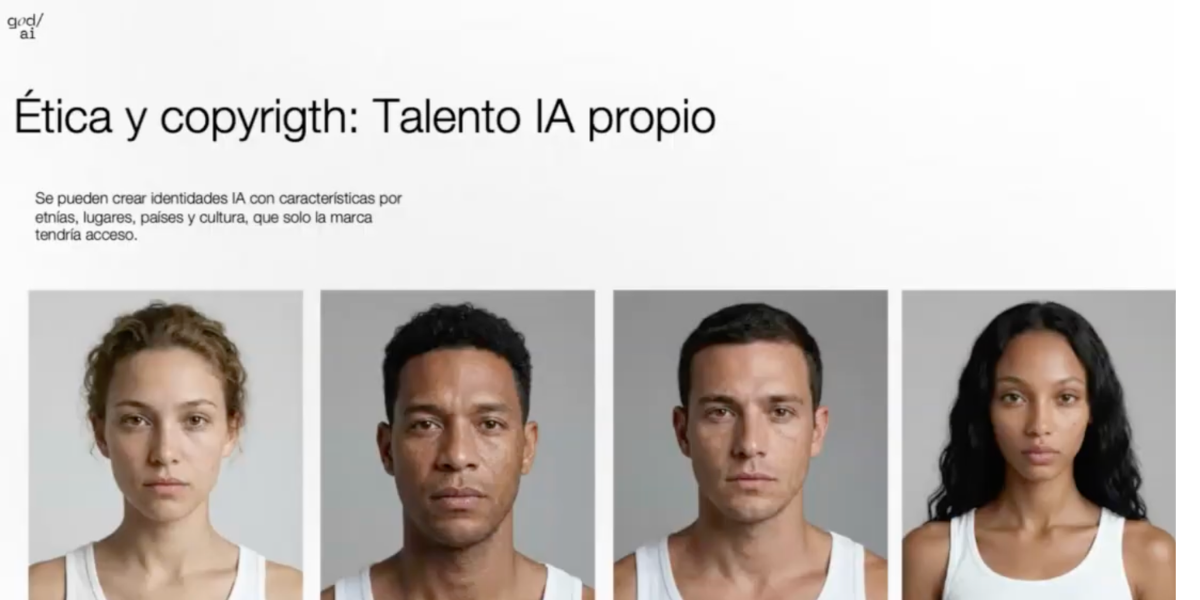
Ethical responsibility: There is a personal ethical boundary in using AI, especially when generating content that evokes third-party brands or styles without permission, which sits on the edge of copyright infringement.
Process auditing: Everything on these platforms is logged, making it vital to be transparent with clients regarding our processes.
El Feo made a clear distinction between experimenting and solving. While experimentation provides the knowledge of what works, implementation allows that knowledge to be converted into a repeatable service or business workflow.
A standout success story presented during the session was the campaign for the Chilean brand Compara:
The challenge: Lack of brand awareness and a low tendency for users to compare insurance.
The solution: An AI was trained using the face of presenter Marcelo Comparini to create a “content universe”.
The scale: They managed to produce up to eight commercials per day, reaching a total of 100 assets for TV and digital in record time.
The results:The campaign doubled the brand’s sales compared to the previous year and generated 80 million views.
This example demonstrates that AI does not replace ideas; it removes production limits, allowing smaller structures to compete with major multinationals.
The key advice for professionals is to ask themselves: How do you do what you do?. Many creatives mechanise processes without being fully aware of their individual steps. To work effectively with AI, it is fundamental to know how to diagram and think in sequences.
Task identification: By defining our workflow, we can identify exactly where to place AI to optimise time or volume.
Dynamic systems: Using tools like Figma and data matrices (Excel files), it is possible to generate hundreds of design variations dynamically.
Precision and consistency: By automating the flow, you can change a single data point in a matrix and update 300 variations in real-time, moving away from manual corrections.
This approach allows us to focus on the cognitive process, the most important factor when working with AI, leaving behind the mechanical sequences of daily graft.
The Masterclass concluded with an optimistic outlook: AI allows us to bring ideas to life faster or gives us more time to refine them. In a world where everything can feel uniform and flat, the difference will be made by those with the best ideas and the operational talent to direct the technology.
You can watch the full Masterclass by filling out the following form 👈🏼
If you are a designer looking to implement these working systems into your projects or want to learn how to design with Artificial Intelligence, take a look at our Online Master in Generative Artificial Intelligence for Creatives, starting this May.
Speak with an advisor. 🚀